Follow our illustrated blog on Embedded Software Architecture

How to build a hybrid solar/wind energy harvester?

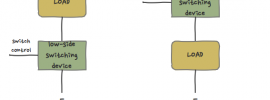
Charge controller high-side / low-side wiring diagrams – part 1

Introduction After exploring the relay solution space (read part1, part2 and part3), we decided to actually change the boundary of the system and move the relay outside of the energy harvester. Main reason is flexibility and scalability: one … [Continue reading]
Programs, processes and threads – Part 1

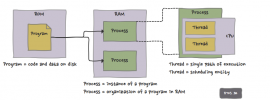
Introduction Especially process and thread are terms which have many different definitions and implementations. And therefor, it is easy to get confused, and hard to get the concepts crystallized in your mind. Just do some googling and you will find … [Continue reading]

Device-internal current and voltage sensing – part 1

The energy harvester application needs to be able to determine current flows and volt charges in order to take the right decisions about charging and dumping. The micro-controller’s ADC unit is able to translate the analogue signal from the sensor … [Continue reading]

Electrical direct current switching boards

high-side mosfet switching board

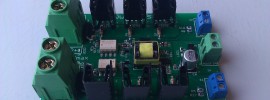
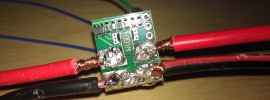
Prototype building block While working on our energy harvester design, we have identified a couple of relatively independent building blocks that could also be interesting for other people doing projects and building prototypes. One building block … [Continue reading]

The energy harvester is ready for iteration 3

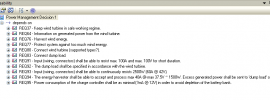
pmd1 requirements traceability

Iteration 2 overview Wind power to dump load switching has been the main topic of iteration 2. In our system design we also call this Power Management Decision 1 (PMD1). PMD1 should realize several system requirements and, because we have an … [Continue reading]

Memory management in embedded devices: Stack or heap?

Understanding memory management is a very important aspect of embedded software development. With a broad and simplified generalization, we will divide memory allocation schemes into 2 categories: allocation on the stack, and allocation on the … [Continue reading]

The linker demystified, part 1

Transforming source code into an executable program involves a number of steps called a software build process. In its simplest form, these steps are limited to a compiler translating source code written in a high-level programming language (such as … [Continue reading]

Investigating the Wind-turbine to dump load switching – part 3, other alternatives

An alternative relay we have not looked at, until now, is the latching or bistable relay. This kind of relay will only use power when changing state from open to close or from close to open. Also, it keeps its last state. Those properties could be … [Continue reading]

MOSFETS

In this article we are going to give a short overview of mosfets and more specifically power mosfets. Surfing the web, we found this great YouTube video (Developed under Teaching Innovation Project 10-170 of Universidad de Granada in Spain) covering … [Continue reading]

Investigating the Wind-turbine to dump load switching – part 2, going the PWM route

In part 1, we talked about the 'contactor'. Relays also use power, and in this particular case, the relay coil could draw up to 2 watts according to its specification. In order to save power, there are a couple of things we can do. Using PWM is one … [Continue reading]