Embedded Systems have reached such a complexity that it has become impossible to design them “from scratch”. That above statement [Seminar “Embedded Systems”, Hardware/Software Partitioning, Frederick Dufour - 2006, July 3rd] is maybe the proverbial … [Continue reading]
I²C and SPI
October 10, 2013 by Leave a Comment
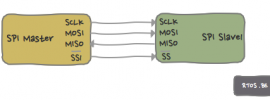
The I²C bus The I²C bus is a multi-node bus. Nodes can have – at a given time - either a master or a slave role. On the one hand, a master node generates the clock and initiates communication with slaves. On the other hand, a slave node receives the … [Continue reading]
Battery charging with the Wind-turbine simulator
October 2, 2013 by Leave a Comment
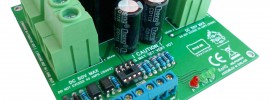
In order to charge batteries with the wind turbine simulator, the setup already becomes quite elaborate. First, there is the brushed DC motor which drives the axial flux turbine. It has a 24V, 350W and maximum 19A rating. The DC motor drives the … [Continue reading]
Charging a deep-cycle battery via low-side mosfet switching: the hard way
September 25, 2013 by 1 Comment
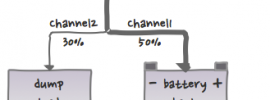
Introduction The core of our charge controller (PMD2) is essentially two switchable mosfet channels: one channel to load a battery (bank) and another channel to divert abundant energy to a dump load. Both channels can be switched on/off by software … [Continue reading]
Building a wind-turbine simulator
September 18, 2013 by Leave a Comment
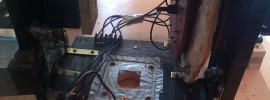
One of the challenges involved in designing and developing the 'energy harvester', is to work out how to design, prototype, test and evaluate software algorithms for managing power flow in the system. At first, we can use powerful lab power supplies: … [Continue reading]
How we work: one year retrospective
September 11, 2013 by
Introduction We started the energy harverster project about a year ago and we thought it might be interesting to our readers to explain how we work and how we get the job done. Of course, bringing the technical challenge to a good end is important … [Continue reading]
Charge controller high-side / low-side wiring diagrams – part 2
September 4, 2013 by Leave a Comment
Connection scheme for low-side switching In comparison to the high-side wiring diagram we saw in part 1, the connections for low-side switching are the other way around: all '+'-s are connected (instead of all '-'-s), and the (power) switching … [Continue reading]
Programs, processes and threads – Part 2
August 28, 2013 by Leave a Comment
This post is Part 2 of the series. Part1, which explains Programs and Processes, can be found here. Thread A thread is a single path of execution and schedulable by the CPU. It has its own stack, program counter and set of registers. A … [Continue reading]
Embedded device communication
August 22, 2013 by Leave a Comment
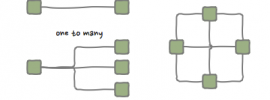
An embedded device does not do its job in the 'void'. It needs to interact (and communicate) with users and/or other devices. Even inside an embedded device, lots of communication is required between controllers and (external) peripherals, sensors … [Continue reading]
Device-internal current and voltage sensing – part 2
August 15, 2013 by Leave a Comment
Attopilot 50V 180A A few weeks ago we tested the Attopilot 50V 90A. Results were ok, we only noticed a small gap between measured and real amps. Today we show you the experimentation results of the 180A Attopilot sensor board. Again, we used the … [Continue reading]




Recent Comments