Follow our illustrated blog on Embedded Software Architecture

How to build a hybrid solar/wind energy harvester?

Mutexes and semaphores: the FreeRTOS implementation

Let us start with an interesting quote from the FreeRTOS web site: Binary semaphores are used for both mutual exclusion and synchronisation purposes. The quote clearly makes a distinction between the two use cases we saw in part 1: mutual … [Continue reading]

Investigating the Wind-turbine to dump load switching – part 1

The (most obvious?) switching solution would be a high-power relay. In a previous article, we already did an experiment with a Solid State relay (and we will continue to do so). Now we will look further into the 'contactor'. The 'kit' we ordered  … [Continue reading]

User level spin locks revisited

This article was written - quite a few years ago - but recent activities made it worthwhile to take another look at it,  revise the content and give it an overhaul to alleviate and clear up some of the inaccuracies. It starts with a quote and … [Continue reading]

STM32F100: why and how to use the internal reference voltage for ADC?

One of our main development boards is the  STM32VLDISCOVERY. Its st-link is an in-circuit debugger and programmer, and makes development for prototyping fast and easy. The board has an 'interesting' property though: its reference voltage is labeled … [Continue reading]

Mutexes and semaphores: two concepts for two different use cases

Introduction There has always been (and there still is) confusion on terminology and usage of mutexes and semaphores. The main reason is that the term 'semaphore' has a different meaning depending on the context. We need to distinguish two contexts … [Continue reading]

The energy harvester is ready for iteration 2

Iteration 1 overview Iteration 1 was mainly about extending our software platform which we call Simple Platform Abstraction. This platform enables us to easily experiment with new hardware (sensors, mosfets etc.) and will be the fundament of our … [Continue reading]

PMD1 sensor board: our first hardware component

We are pleased to announce the creation of our very first hardware component: the PMD1 sensor board. We won't let you wait, here is a beautiful image: Now, let us start with the global picture. The sensor board is part of Power Management … [Continue reading]

Reverse engineering the bug of my Opel Zafira’s volume knob (with movie!)

The bug Some articles ago we proudly introduced the Opel Zafira's electronic handbrake in order to explain de-bounced buttons. We now have some more bad news for the guys from Opel: the volume knob of the car has a bug. We admit... it is a very … [Continue reading]

System safety: hazard analysis

Introduction The goal of each system is to perform its intended function. Easier said than done in an imperfect world, and that is what this article is about: how to design a system in such a way that the probability of hazard exposure is … [Continue reading]

Pulse Width Modulation

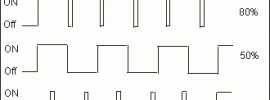
A short definition Pulse-width modulation is commonly used in power-control or motor-control applications. Time is divided into periods. As always, the smaller the time periods, the higher the frequency. Within this time block a pulse signal is … [Continue reading]